Closing the house up before cold weather
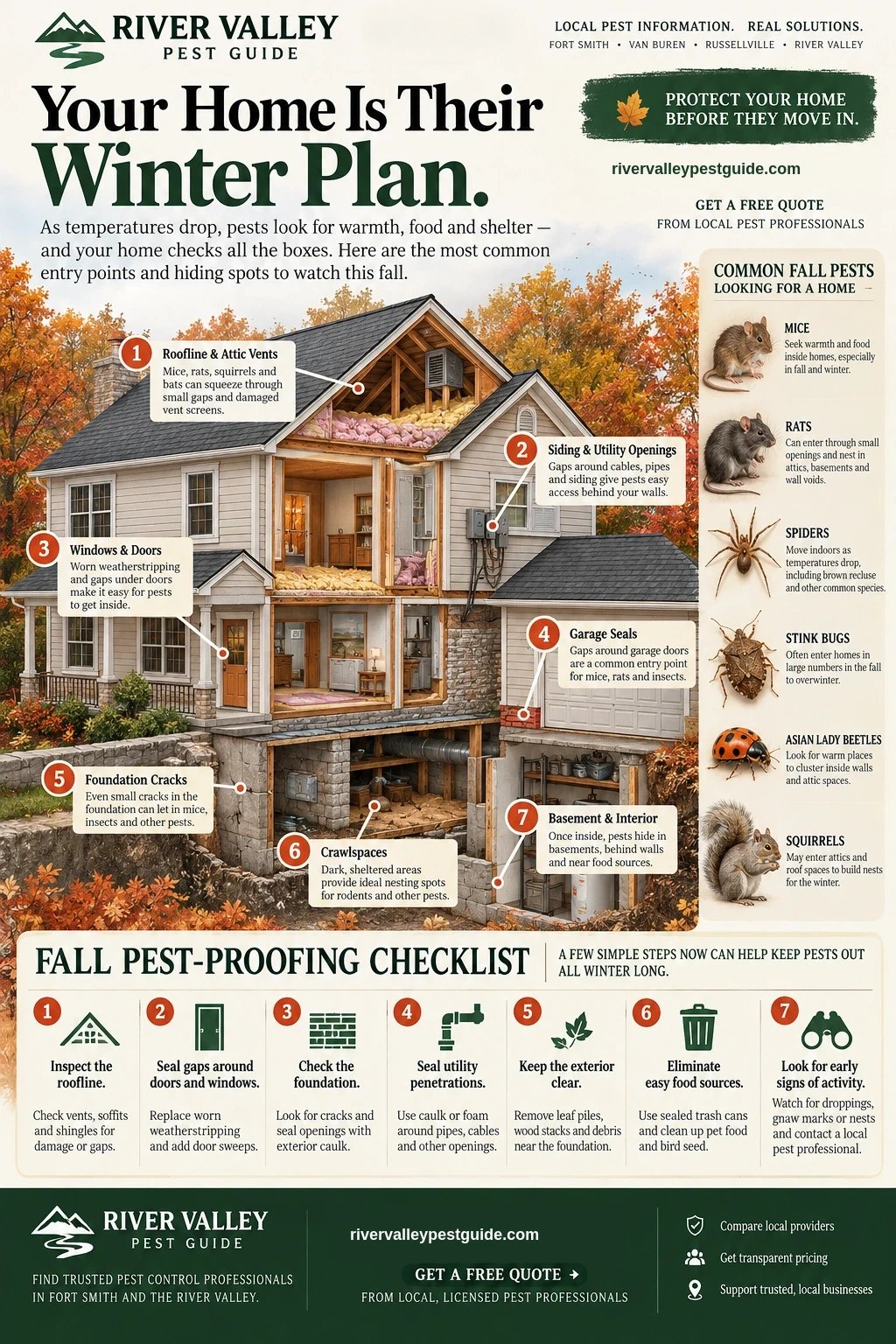
Pests move indoors for the same reason you turn the heat on: warmth, shelter and a steady supply of food. The housing around Fort Smith and Van Buren makes that easy. Much of it is mid-century or older, with crawlspaces, attached garages and decades of small gaps around pipes, vents and sill plates.
The seven routes on the first guide are the ones that come up again and again here. Roofline and attic vents take squirrels and bats as well as insects. Siding and utility penetrations are how mice reach wall voids. A garage door with worn seals is the most common first entry point for rodents across the metro.
Most of this work is sealing rather than spraying. Caulk and foam at the foundation and utility penetrations, new weatherstripping at the doors, and hardware cloth over vents do more than any treatment applied after animals are already inside.
Do this before the first hard freeze
Once the temperature drops, rodents are already in the wall voids and the job shifts from exclusion to removal. Sealing in October costs less than trapping in January.

Share this one
Pests do not take winter off. They move in. Seven ways they get into a house once the weather turns, and the seven things that stop them. Worth saving for October.
What subterranean termites are doing under a house
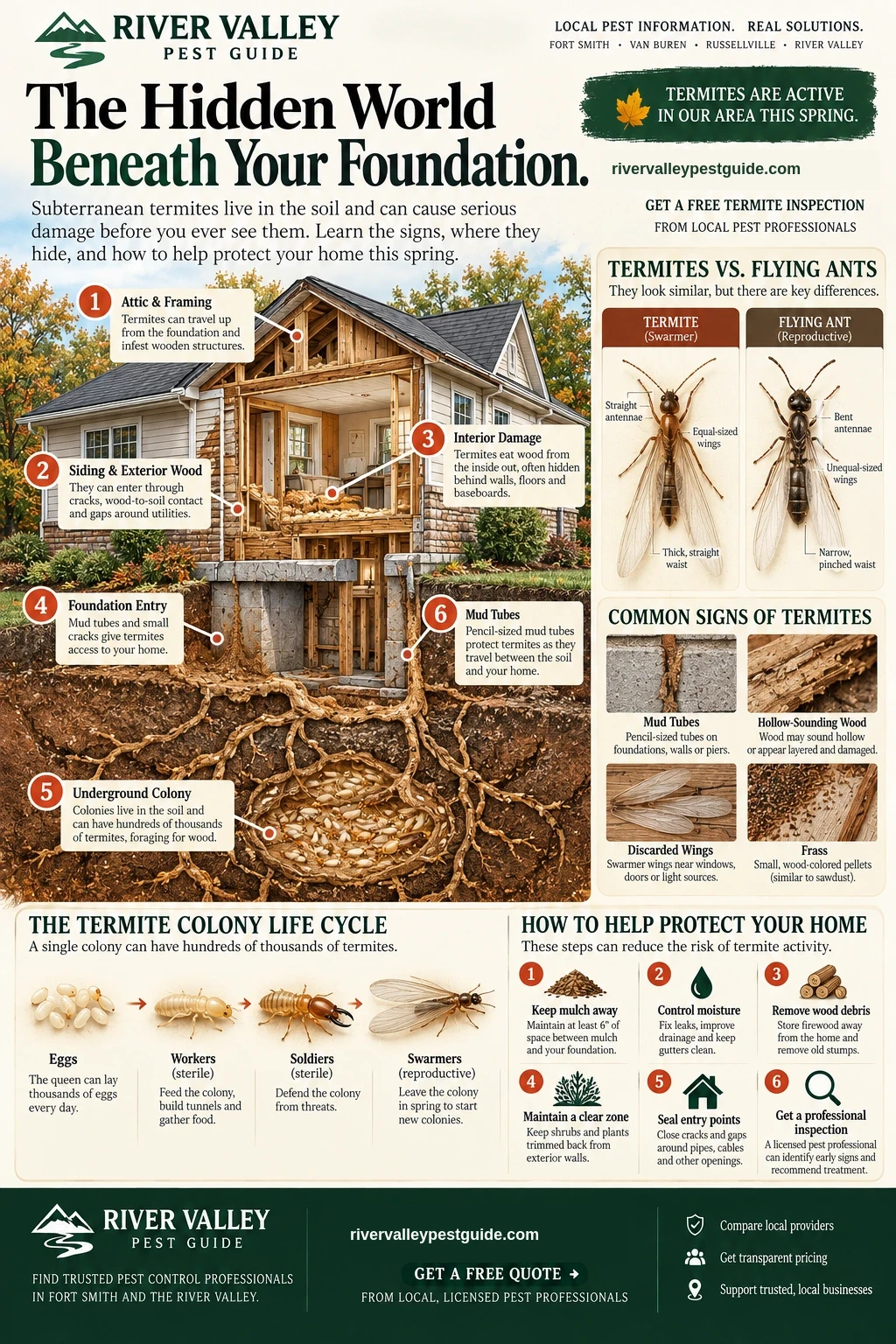
Arkansas sits in the termite belt, and the river terrace around Fort Smith is ground they prefer: deep, moist alluvial soil with a lot of buried wood in it from a century of building. Colonies live in the soil and forage upward, which is why the first evidence is usually a mud tube on a foundation wall rather than damage anyone can see.
The spring swarm is the part people notice. Winged reproductives leave the colony in a warm spell, mostly March through May here, and shed their wings near windows and door frames. A small pile of wings indoors means a mature colony is close enough to reach the house.
Telling a termite swarner from a flying ant is worth the trouble, because the two problems are priced very differently. Straight antennae, wings of equal length and a thick waist mean termite. Bent antennae, unequal wings and a narrow waist mean ant.
- Keep mulch off the wall — Mulch holds moisture against the foundation. Six inches of clearance between mulch and siding removes the cover termites use to reach the sill.
- Move firewood away — Wood stacked against the house is a bridge straight into the framing.
- Fix the drainage — Standing water and leaking gutters keep the soil at the foundation damp all year.
- Inspect on a schedule — An annual termite inspection costs little next to sill and joist repair. Have it done whether or not the house has been treated before.
Share this one
Most termite damage is found before anyone sees a termite. These are the mud tubes, discarded wings and hollow wood that give them away, plus the one test that tells a termite swarm from flying ants. Have a look every spring.
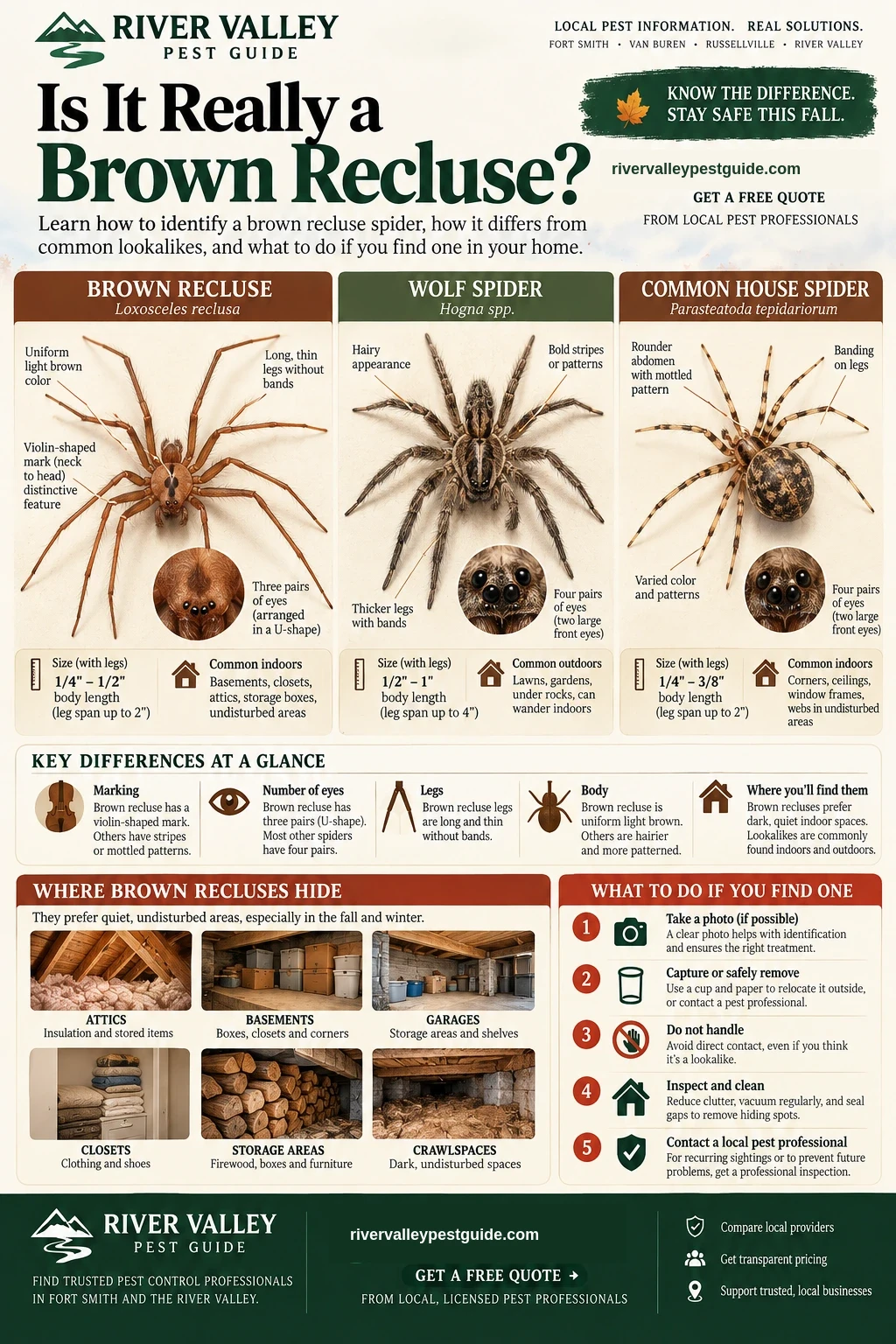
Brown recluse, and the spiders it gets mistaken for
The Fort Smith area sits inside brown recluse range, so every house here has some exposure and no house can be made entirely free of them. What can be reduced is their presence in the rooms you actually use.
The identification test that holds up is on the guide: brown recluse have six eyes arranged in three pairs, where nearly every spider they are confused with has eight. The violin mark helps, but the eyes are what settles it. Wolf spiders, house spiders and cellar spiders are brought in as brown recluse constantly.
Where they are matters as much as what they look like. Recluse prefer dark, undisturbed storage: attics with cardboard boxes, garages, closets and crawlspaces. That is why the usual advice is gloves when you handle stored items in those places, rather than spraying everywhere in the house.
If you are bitten
Keep the spider if that can be done safely, take a photograph, and get medical attention rather than treating it at home. A clear photograph helps with identification and with getting the right care.
Share this one
Most brown recluse sightings are not brown recluse. Three spiders side by side, and the test that settles it: brown recluse have six eyes in three pairs, where almost every lookalike has eight. Here is where they hide and what to do if you find one.
What to do with these
Print any of them and put them where the work gets done: the garage wall, the crawlspace hatch, the inside of a utility cupboard. They are sized to read at arm’s length.
They also pass on cleanly. Neighbours on the same street are dealing with the same housing and the same ground, so a guide that applies to your house usually applies to theirs. If you manage rental or commercial property, the fall and spring ones are worth sending to tenants before the season turns.